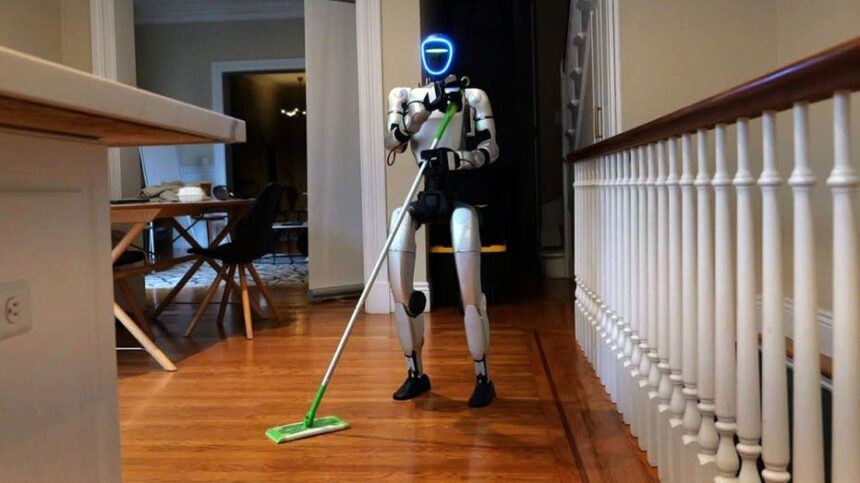
A just walked into someone’s San Francisco apartment and cleaned it. Yes, really.
Gatsby, a local robotics startup operating under West Egg Labs, says it has completed the by a humanoid robot in the United States. The customer came from Gatsby’s San Francisco waitlist, was picked at random and booked the cleaning through the company’s iOS app.
With Gatsby, instead of buying a pricey robot for your home, you book one when you need it, much like ordering a ride or food delivery from an app.
Sign up for my FREE CyberGuy Report
Gatsby describes itself as an on-demand cleaning service in San Francisco that uses instead of human cleaners. You open the iOS app, pick a time and a robot shows up to clean your apartment.
This is not a robot vacuum. Gatsby says it uses full-size humanoid robots that walk through the apartment and handle chores such as dishes, surfaces, floors, making the bed and folding laundry.
The price is also part of the hook. Gatsby says it charges a flat $150 per clean, regardless of apartment size. That means a studio and a penthouse cost the same, with no tips, hidden fees or surcharges, according to the company. Gatsby compares that with typical San Francisco apartment cleaning services, which it says often run from $150 to $300. Gatsby says the robot cleaned the customer’s entire apartment on its own, with no human cleaner physically inside the home. The company also says a typical cleaning takes about 3 hours. One recent San Francisco cleaning ran from 8:42 a.m. to 11:47 a.m., with one robot and no human cleaner physically present.
Gatsby says no human cleaner is physically present during the clean. For anyone who has ever cleaned frantically before the cleaner arrives, that may sound appealing. However, that does not necessarily mean there is no human involvement at all. Gatsby says harder tasks can be handled through remote human teleoperation, while routine work is autonomous. So, while a person may not be standing in your apartment, the service may still involve remote human help.
That detail does not erase the milestone. But it does change how people should think about privacy, trust and what “autonomous” really means inside a home.
Cleaning makes sense as a starting point because almost everyone has some relationship with it. Some people hate it. Some people outsource it. Others squeeze it in late at night because the day got away from them.
Gatsby founder and CEO Aron Frishberg frames housework as more than an He sees it as a time problem that falls hardest on people who are already stretched thin.
“Housework is the largest unpaid job in human history, and it falls hardest on the people with the least time to give,” Frishberg said. “Right now, somewhere, there’s a parent scrubbing floors who would rather be with their kid. A worker mopping after a sixteen-hour shift. We’ve mapped every neuron and synapse in a fruit fly’s brain, yet we still clean our homes the same way our ancestors did hundreds of years ago. We didn’t build this to clean apartments, we built it to give that time back to humanity.”
Many humanoid robot companies want to build and sell the machine itself. Gatsby is trying a different route. The company says it is building the consumer distribution layer for humanoid robotics. In other words, Gatsby wants to be the app and service layer that connects customers with whichever humanoid robot performs best.
That could be smart if the robotics market keeps changing quickly. A better robot may arrive six months from now. A cheaper one may show up after that. Gatsby wants the flexibility to swap in stronger hardware while keeping the same app, booking flow and service model. The company describes itself as robot-agnostic. That means Gatsby is not betting everything on one robot body. It wants to work with multiple robot makers as the technology improves.
Home cleaning is brutally hard for robot